Click to view book at IndieBound. Image credit: IndieBound.
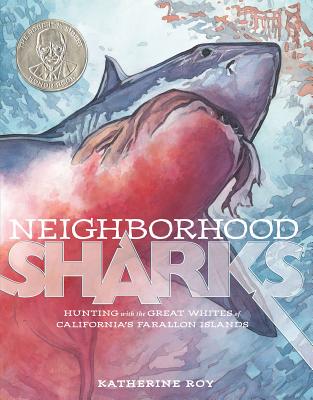
Evaluating the work of authors we love is one way to improve our own writing. Today I’m looking at Neighborhood Sharks, by Katherine Roy, and examining how the author crafted a compelling beginning.
The first sentence of Neighborhood Sharks, “every September, the great white sharks return to San Francisco,” successfully sets up the rest of the book, prompting the reader to wonder where the sharks are returning from and why they are traveling to that particular spot.
As the first lines unfold, Roy slowly builds tension. She uses our natural unease about great whites to wind us up, but she also uses language. Not only does she build a word picture of sharks stalking their prey, she uses the sound of language to great effect. The sharks “circle” and “stalk,” they are “silent” and they “STRIKE!” The repeated “s” sound help the sharks seem scary and sinister.
Now Roy doesn’t just leave us here. The book goes on to take the reader on a journey from fear to fascination to sympathy. But her first lines are a master class on how to create a great beginning.
I suggest you buy or check out a copy of Neighborhood Sharks and really look at the first few pages. Compare it to your own work and see what you can learn.
Here are some things to consider as you evaluate both mentor texts and your own work:
- Does the entire rest of the story spring from the first line?
When editing, I often see first lines that don’t really have much to do with the rest of the book. Think about the end of the book. Now imagine winding the entire story back up like a ball of yarn. If you get back to the beginning and those first lines don’t logically tie into everything else on your ball of yarn, especially the end, then you need to think about reworking them.
- What is the emotional journey the book will take the reader on? Are you establishing the beginning emotion early on?
- How is the language you choose adding to the intended emotional starting point?